
Parents and Educators,
I hope you had a wonderful Yom Tov! Welcome back to school and to the start of homework. Again.
So, how do you have students efficiently do their homework — When it’s so difficult to get things together?
For as long as homework has existed, it’s been a challenge for parents, teachers, and educators.
#1 Understand the challenge:
- Completing homework is a process that takes place over three locations: 1. school 2. home 3. back to school again, with steps to get stuck in each one.
- Getting the details is tough when the teacher quickly assigns the homework and students miss out on important words. Many times, students weren’t paying attention and completely lose the mention of any homework.
- Prioritizing- sequencing the homework such as starting with studying for the grammar test or doing the math worksheet- which one should be done first?
- Procrastinating and pushing homework off due to:
- Initiation difficulties (don’t know where/how to start)
- Lack of a homework routine
- Unclear with the material or the instructions
- Uncaring- unmotivated or lazy students don’t care enough about school to remember homework. There is so much more to life than school!
But homework happens. And it teaches our students responsibility and more. So how can we support our students struggling with one of the challenges detailed above?
Imagine a Homework Road that students drive through as they go through their homework process, starting with getting the assignment details and ending with classroom review and paper filing. As your student is driving on the Homework Road, the skill level of the driver is challenged. Noticed the signs? Slowed down speed to get the details? Most of the challenges are like potholes or signs on the road, observable and predictable if the driver knows to look ahead, but throws the driver off balance if unprepared.
My dear friend (and fellow parent & educator), I am unveiling this secret to you: homework is difficult for students, too!
#2 Discuss homework challenges
Sit down for an open discussion about homework challenges and figure out where the student’s potholes are. Use this super-clear checklist to guide your discussion. Keep your tone of voice neutral and be open and curious- no getting defensive, judgmental or resentful. You can start by saying, “I noticed that whenever you need to start your homework, you (describe student’s behaviors) ….”
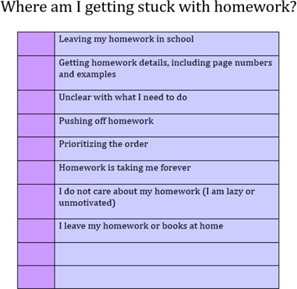
#3 Strategize and solutionize
Once the potholes have been discovered, strategize and problem-solve.
Create a consistent routine to avoid procrastination and bring structure, including a set time, such as 6:30 is homework time, or after a set task, such as after dinner. When setting the time consider your student’s personality, home structure, and homework load. Events such as weddings and appointments have advance notice and are not emergencies- homework plans can be made ahead of time, teaching flexibility and problem-solving.
Prioritizing is a personal preference. For some, difficult homework should be done first to free up the brain, while for others, easy homework should be done first reserving brain energy.
Create a positive environment for homework studying. Bedroom desks give students a sense of
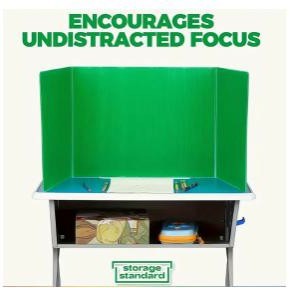
privacy and a quiet environment. A lap desk is a great option if space is limited. During Covid when I had my children home and the noise level was impossible to limit, my noise-sensitive daughter wore noise-canceling headphones while everyone was doing their homework together around the dining room table. It worked! A privacy partition gives students the opportunity to create a

homework oasis in a busy room. You can add command strips and attach supplies and decorate the space so students enjoy doing their work! Assemble a homework pencil case with basic school supplies such as pencils, pens, eraser, white out, highlighters, expo marker and post-its. Keep it organized and handy such as a bedroom drawer.
Break the homework down into manageable steps.
- What do you have for homework? See what needs to get done
- Check for clarity with tonight’s Have a phone number of a classmate handy for quick questions.
- Get the homework pencil
- Dive right in, prioritizing if there is more than one
- Collect parent signature if
- Pack This includes putting your sheets and books back into the briefcase and putting away the pencil case.
- All done!
Newly developed skills need consistent practice to become automatic. To develop Homework Habits use a rewards chart, with smaller rewards built in every 10-15 days to keep the momentum going. Rewards could be as simple as a private walk with mommy or a small chocolate treat. Build motivation.
#4 Refine and tweak
After the plan is created, it needs tweaking. Follow the homework routine closely for the next 2-4 weeks to see what comes up. Solutionize as soon as a problem arises more than twice. (That’s a pothole alert!)
Doesn’t know what is for homework?
- Practice paying attention and getting the details by randomly “giving” Your student learns to tune in, get the details, and write it down. Pick up speed and be less clear as the skill improves, until you match the grade level teacher.
Does homework take forever? (student and parent left e x h u s t e d)
- Set a time timer with an estimated time per assignment and check in when half-way through to see if adjustment is needed.
- See if your student is stuck and sits over the question instead of learning how to look for answers or asking an adult for help. Teach her what do when she gets stuck.
There you have it:
- Understand the challenge to understand your student
- Discuss homework challenges
- Strategize and Solutionize
- Refine and tweak
Click here to view the latest research on how to properly set up homework. Do you have any questions or tips? How do you resolve the homework haze?
I read every email and love supporting your struggles.
‘To a super-smooth homework season,
Rachel Gluck
P.S. — The Start It Plan saves many students life and guides you to set up an effective homework system.
Do you want training only in HOMEWORK? Email us and we will save the day! Ready to dive in — Become a Coach today!